
When a child struggles with speech, it can feel overwhelming for parents. Questions, worries, and uncertainty often take over — “Is my child falling behind?”, “What can I do to help?”
The good news? With the right approach and tools, children with speech delay can make remarkable progress. One such powerful method gaining attention in 2026 is Jolly Phonics — a structured, fun, and highly effective way to build strong communication skills.
In this blog, we’ll break down how Jolly Phonics works, why it’s beneficial for children with speech delays, and how you can use it to support your child’s learning journey.
What Is Speech Delay?
Speech delay occurs when a child is not developing speech and language skills at the expected rate for their age. This may include:
- Difficulty pronouncing words
- Limited vocabulary
- Trouble forming sentences
- Struggling to express thoughts clearly
While every child develops at their own pace, early support can make a huge difference in their confidence and communication skills.
What Is Jolly Phonics?
Jolly Phonics is a systematic, multi-sensory approach to teaching reading and writing. It focuses on teaching children the sounds of letters (phonics) rather than just memorizing the alphabet.
It uses:
- Sounds (phonemes)
- Actions (body movements)
- Visual cues (images & stories)
This combination makes learning engaging, interactive, and easier to retain — especially for children with speech challenges.
Why Jolly Phonics Works for Speech Delay
1. Multi-Sensory Learning Boosts Retention
Children with speech delays often benefit from learning that engages multiple senses. Jolly Phonics combines:
- Hearing (listening to sounds)
- Seeing (visual associations)
- Doing (actions & gestures)
This strengthens neural connections and improves learning speed.
2. Focus on Sounds, Not Just Letters
Instead of teaching “A for Apple,” Jolly Phonics teaches the sound /a/.
This is crucial because speech delay is often linked to difficulty in recognizing and producing sounds. By focusing on phonemes, children:
- Learn correct pronunciation
- Develop better articulation
- Improve listening skills
3. Builds Confidence Through Small Wins
Children with speech delays may feel frustrated or shy. Jolly Phonics breaks learning into small, achievable steps, helping them:
- Experience success regularly
- Stay motivated
- Build self-confidence
4. Encourages Active Participation
The use of actions (like hand movements for each sound) makes learning:
- Fun
- Interactive
- Less stressful
Children don’t feel like they’re “studying” — they feel like they’re playing.
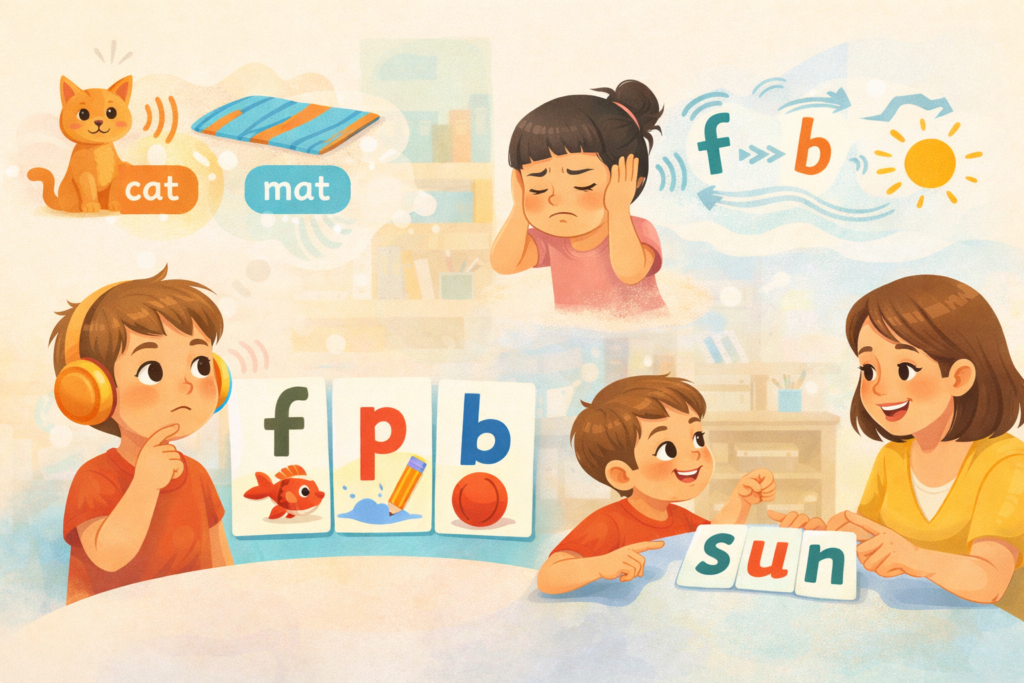
5. Improves Listening & Sound Discrimination
A key challenge in speech delay is distinguishing between sounds. Jolly Phonics trains children to:
- Hear subtle differences
- Identify sounds in words
- Blend sounds into complete words
This directly improves both speech and reading skills.
Key Jolly Phonics Skills That Help Speech Development
Jolly Phonics focuses on five essential skills:
1. Learning Letter Sounds
Children learn 42 letter sounds instead of just the alphabet.
2. Blending
Combining sounds to read words (e.g., c-a-t → cat)
3. Segmenting
Breaking words into sounds for spelling
4. Identifying Sounds in Words
Helps improve pronunciation and clarity
5. Tricky Words
Learning common words that don’t follow phonetic rules
How Parents Can Use Jolly Phonics at Home
You don’t need to be a teacher to support your child. Here are simple ways to start:
✔ Practice Daily (10–15 Minutes)
Short, consistent sessions work better than long ones.
✔ Use Actions Along with Sounds
For example, while teaching the sound “s,” make a snake movement.
✔ Encourage Repetition
Children with speech delay need more repetition — and that’s okay!
✔ Make It Fun
Use games, songs, and storytelling to keep your child engaged.
✔ Celebrate Progress
Even small improvements deserve appreciation.
Signs of Improvement to Look For
With consistent practice, you may notice:
- Clearer pronunciation
- Increased vocabulary
- Better sentence formation
- Improved confidence in speaking
- Interest in reading and writing
Remember, progress may be gradual — but it will come.
When to Seek Additional Help
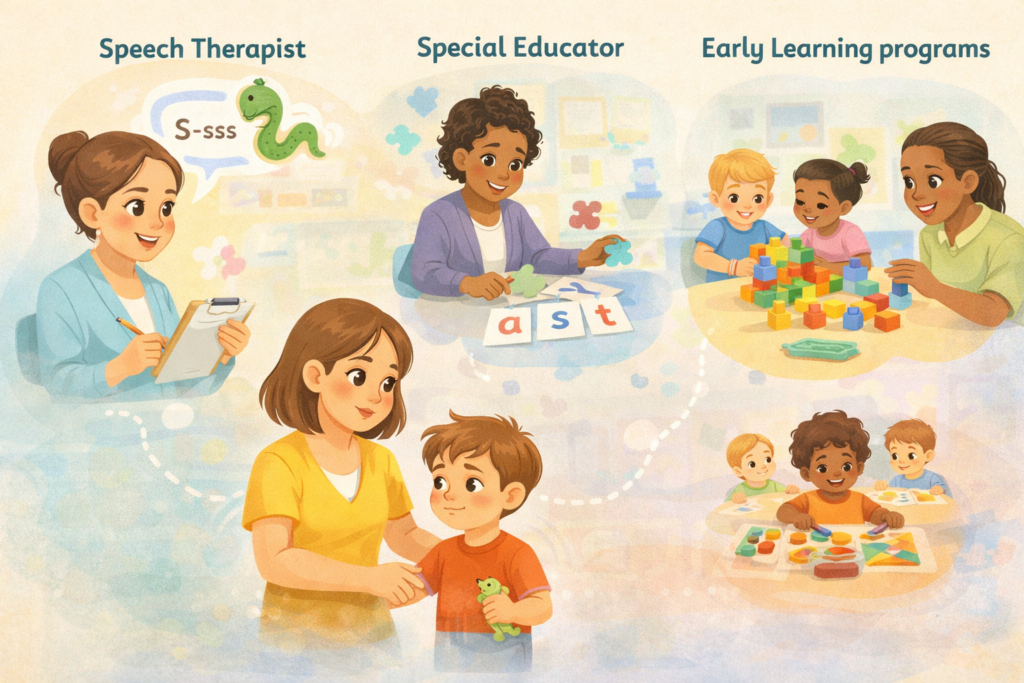
While Jolly Phonics is powerful, some children may also need support from:
- Speech therapists
- Special educators
- Early learning programs
- Combining professional guidance with phonics learning often gives the best results.
Why Early Intervention Matters in 2026
In today’s fast-paced, digital-first world, communication skills are more important than ever. Early intervention helps children:
- Perform better academically
- Build social skills
- Develop confidence early on
The sooner you start, the better the outcome.
How The Learning Barn (TLB) Can Help
At The Learning Barn (TLB), we understand that every child is unique. Our specialized programs are designed to support children with speech delays through:
✨ Expert-led Jolly Phonics sessions
✨ Personalized learning plans
✨ Engaging and child-friendly teaching methods
✨ Focus on confidence-building along with academics
We don’t just teach phonics — we help children find their voice.
👉 Give your child the right start today!
Enroll in TLB’s Jolly Phonics program and watch them grow into confident communicators.
FAQs
1. Is Jolly Phonics suitable for children with speech delay?
Yes, it is highly effective because it focuses on sound recognition and uses multi-sensory learning techniques.
2. At what age can I start Jolly Phonics?
You can start as early as 3 years old, especially if a speech delay is noticed.
3. How long does it take to see results?
Every child is different, but noticeable improvements can often be seen within 3–6 months with consistent practice.
4. Can Jolly Phonics replace speech therapy?
No, it complements speech therapy. For best results, both can be used together.
5. How often should my child practice?
Daily practice of 10–15 minutes is ideal.
6. What if my child is not interested?
Use games, songs, and interactive activities to make learning fun and engaging.
Final Thoughts
Speech delay doesn’t define your child’s future — the right support does.
Jolly Phonics is more than just a learning method; it’s a confidence-building tool that empowers children to communicate, express, and succeed.
And with the right guidance from platforms like The Learning Barn (TLB), your child can truly thrive.
Start early. Stay consistent. Celebrate every small step.
