
Many parents feel reassured when their child confidently recites all 26 letters of the alphabet. Knowing the ABCs is often seen as an important first step in early education. However, concern usually follows when the same child is unable to read simple words like cat, bat, or sun, even after learning the phonics sounds of the alphabet in a limited or unclear way.
If your child knows the alphabet but cannot yet read words, this situation is more common than you may think. It does not indicate a learning problem. Instead, it highlights a missing foundational skill in early reading: a clear understanding and application of the phonics sounds of the alphabet.
This gap in early reading often occurs because children are taught what letters are called before they are taught what letters do. While alphabet recognition is useful, reading requires children to actively use the phonics sounds of alphabets to make sense of written words. Without this sound awareness, children may rely on guessing, memorising word shapes, or looking at pictures to identify words. These strategies may work briefly but do not support long-term reading development. Over time, this can lead to hesitation, slow reading, and frustration when texts become more complex.
Understanding the phonics sounds of alphabets helps children see reading as a logical process rather than a memory task. When a child knows that each letter (and group of letters) represents a sound, they begin to decode words independently. For example, instead of remembering the word cat as a whole, the child learns to blend the sounds /c/–/a/–/t/ to read it accurately. This approach builds confidence and encourages problem-solving during reading. As children gain mastery over sounds, they are better prepared to read new words, spell correctly, and develop fluent reading skills. Strengthening this foundation early supports not only reading success but also comprehension and clear communication in later learning stages.
Alphabet Knowledge vs Reading Skills
One of the most common misunderstandings in early education is assuming that alphabet knowledge automatically leads to reading ability. In reality, reading depends on understanding the phonics sounds of the alphabet, not just letter names.
- ABCs teach children the names of letters
- Reading requires recognising the sounds each letter makes
For example, the letter C is named “see,” but in reading, it produces the sound /c/ as heard in cat. When children know only letter names, they struggle to blend sounds together, which is essential for reading words.
Why Children Struggle Despite Knowing the ABCs
Traditional learning approaches often emphasise:
- Memorising alphabet sequences
- Repeating letter names
- Writing letters without sound awareness
While these methods help children recognise and write letters, they do not explain how letters work together in words. As a result, children may:
- Identify letters correctly
- Recite alphabets fluently
- Still struggle to read even simple words
This gap between recognising letters and reading words can lead to confusion, guessing, and reduced confidence.
How Phonics Builds Real Reading Skills
Phonics focuses on teaching children how letters function in language. By learning the phonics sounds of alphabets, children begin to understand the structure of words.
Phonics-based learning helps children:
- Identify individual letter sounds
- Blend sounds to read words
- Break words into sounds for spelling
Instead of memorising whole words, children learn a decoding process that allows them to read unfamiliar words independently. Programmes such as Jolly Phonics use actions, songs, stories, and multisensory activities to make sound learning natural and engaging.
How Parents Can Support Early Reading
Parents can play an important role in building reading readiness by:
- Encouraging sound-based learning rather than memorisation
- Focusing on listening and speaking activities involving sounds
- Avoiding pressure to read before understanding sounds
- Choosing structured phonics programmes over worksheet-heavy methods
When children understand sounds first, reading becomes logical rather than stressful.
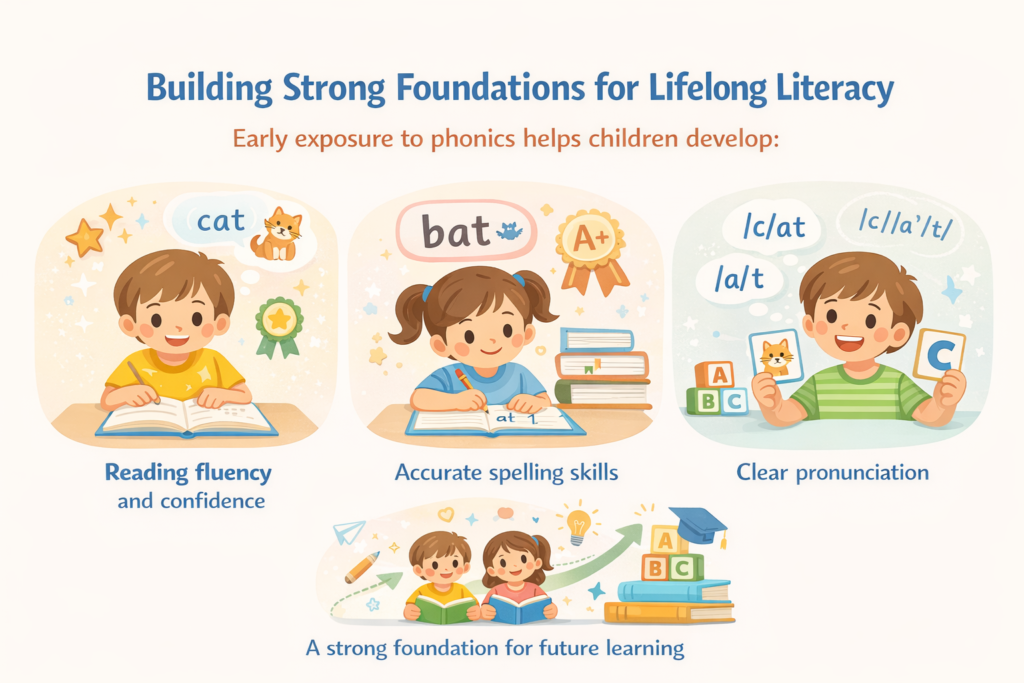
Building Strong Foundations for Lifelong Literacy
Early exposure to phonics helps children develop:
- Reading fluency and confidence
- Accurate spelling skills
- Clear pronunciation
- A strong foundation for future learning
At The Learning Barn Academy, children are guided from alphabet awareness to independent reading through structured, age-appropriate phonics instruction. The emphasis remains on understanding, confidence, and joyful learning.
When children master the phonics sounds of alphabets, reading becomes a natural next step.
Still wondering how phonics can help your child read confidently?
Contact us now for a FREE demo class and experience the power of sound-based learning firsthand.
FAQs
1: Why does my child know ABCs but still struggle to read words?
Knowing ABCs means a child recognises letter names, but reading requires understanding the phonics sounds of alphabets. Without sound awareness, children cannot blend letters to form words, which is why reading may feel difficult even after learning the alphabet.
2: What are the phonics sounds of alphabet, and why are they important?
Phonics sounds of alphabets refer to the sounds each letter makes in spoken language. These sounds help children decode words by blending letters together. Learning phonics is essential because it teaches children how to read, not just what letters look like.
3: At what age should children start learning phonics sounds of alphabets?
Children can begin learning phonics sounds of alphabets as early as 3 years old, provided the teaching is playful, interactive, and pressure-free. Early phonics builds strong reading foundations and prevents confusion later in school.
